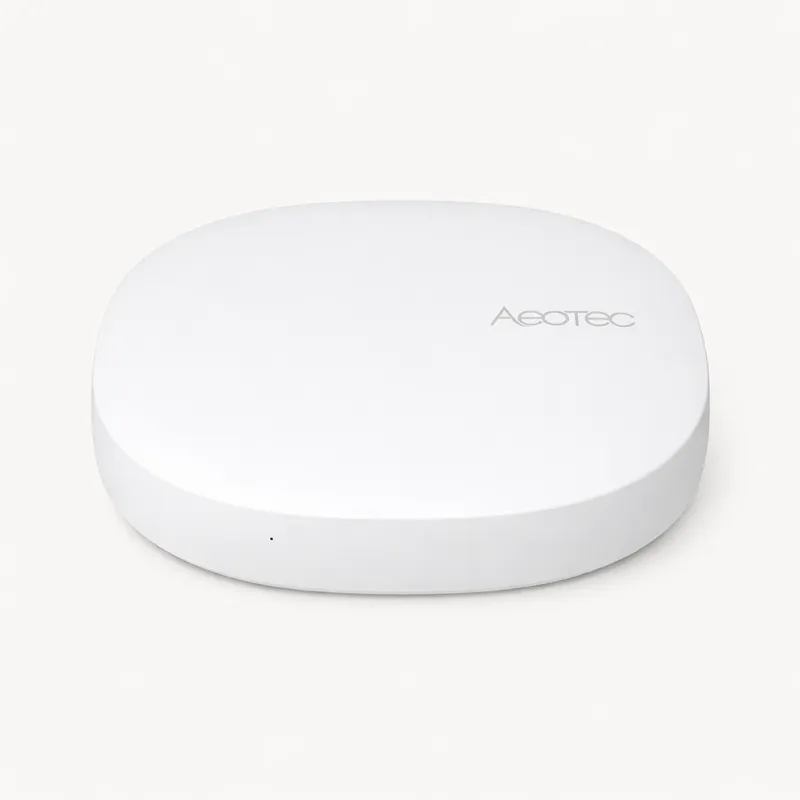
Samsung discontinued its SmartThings Hub hardware in 2023, but the SmartThings platform lives on through the Aeotec Smart Home Hub — same chipset, same Zigbee and Z-Wave radios, same SmartThings app, different badge on the front. Aeotec built the hub under licence from Samsung, and it is the device Samsung itself directs customers to when they ask about dedicated SmartThings hardware. If you want the SmartThings platform on dedicated hardware, this is your only current option.
The hardware case for the Aeotec hub is its protocol breadth. At $149.99, it is the only hub in this guide that combines Zigbee, Z-Wave, and Matter in a single box without requiring a $399 Homey Pro or a self-assembled Home Assistant build. Z-Wave support is particularly relevant for security-grade devices: Schlage, Kwikset, and Weiser smart locks use Z-Wave as their primary protocol, as do many professional-grade motion sensors and door contacts. If your smart home includes or will include Z-Wave locks, the Aeotec hub gives you the broadest device compatibility of any consumer hub at this price.
Local execution is another meaningful differentiator. SmartThings supports local processing for a defined subset of compatible devices and SmartApps, which means certain automations continue running during internet outages. This is not full local control in the way Hubitat Elevation provides it — cloud-dependent automations still pause when connectivity drops — but it is meaningfully better than the Echo Hub or Nest Hub Max, which rely entirely on cloud routing for automation execution. For buyers who want some resilience without the complexity of a fully local hub, SmartThings local execution is a practical middle ground.
The SmartThings app is the most powerful smart home management interface available in a consumer hub — and that power is its double-edged characteristic. Where the Echo Hub's Routines are designed for simplicity and Google Home's Scenes for approachability, SmartThings gives you Routines, Scenes, and Rules as overlapping automation systems. Advanced users gain deep flexibility; newcomers face a steep learning curve. Setting up a conditional automation — "turn on the hallway light when motion is detected after sunset, but not when the home mode is set to Away" — requires navigating SmartThings menu layers that are not intuitive on first encounter.
The Matter implementation is solid but missing Thread. The Aeotec hub supports Matter devices over Wi-Fi and Ethernet, which covers most current Matter accessories. However, there is no Thread radio on the hub, meaning battery-powered Matter-over-Thread devices require a separate Thread border router running alongside it. This is the most notable hardware gap versus the Amazon Echo Hub, which includes a Thread radio at a similar price point.
Samsung's ecosystem integration is the SmartThings platform's strongest attribute at the integration layer. Samsung appliances — washing machines, refrigerators, dishwashers, air conditioners — integrate with SmartThings in ways no other platform matches. If your home includes Samsung appliances, SmartThings is the natural control platform. More broadly, the SmartThings platform connects with Alexa, Google Home, and a wide range of third-party devices and services, providing one of the more comprehensive integration libraries in the consumer hub market.
At $149.99, the Aeotec hub has seen significant price inflation from Samsung's original $70 SmartThings Hub. That puts it within $5 of the Hubitat Elevation C-8 Pro ($149.95), which offers fully local processing, native HomeKit, Matter 1.5, and Z-Wave 800 LR. The choice between them comes down to platform preference: SmartThings for households invested in Samsung appliances and the SmartThings ecosystem, or Hubitat for users who prioritise privacy, local control, and advanced automation depth without cloud dependency.
The Aeotec Smart Home Hub is the right answer for households with a mix of Zigbee, Z-Wave, and Matter devices who want the SmartThings platform specifically, Samsung appliance owners who want unified app control, and power users who want broad device compatibility at the $150 price point without the complexity of Home Assistant. It is the wrong answer for newcomers seeking simplicity, HomeKit households, and buyers who prioritise local processing — Hubitat Elevation is a materially better fit for those use cases.